
Share price
245.4 SEK
Mips AB (Mips) -4.52 SEK (-1.84%)
Last updated 9 April 2026, 22:41 CEST
SEKm
Net sales
SEKm
Operating profit
Operating margin
Distribution of net earnings
*Operating profit adjusted for items affecting comparability
**Proposed dividend for 2025
Mips´ strategy builds on three strategic pillars: Grow the existing business, open up new channels and markets and, capture new opportunities within helmet safety. Mips´ financial targets are:
Growth
Net sales no later than 2029
Profitability
EBIT margin
Dividend policy
Dividend of annual net earnings
Message from the CEO
I am proud that we delivered a solid organic growth of 21 percent in 2025. We continue to show strong momentum in Europe, continue to win market share in the European market and our European helmet brands are equipping more and more helmet models with Mips’ safety system. On our large US market, the market dynamics were challenging. Sales to our customers was volatile due to the US tariff uncertainties during the year. Despite this, we succeeded in delivering organic growth even on the US market. When we summarize the year globally, we saw continued healthy progress in all our categories.
I am very excited about the prospects that the acquisition of Koroyd finalized in December, as it opens the door to new strategic long-term opportunities for us. Koroyd’s main business is currently in helmets, but has recently also launched products in related categories such as body protection, protective gloves and footwear. Koroyd shares many similarities with Mips, particularly in terms of its business model, organization and culture and, like Mips, has historically invested heavily in research and development to ensure that it is at the forefront of its business areas.

Max Strandwitz
President and CEO



Mips is a global leader in its field and also aims to be at the forefront of its industry when it comes to sustainability. The company is determined to fulfil the expectations of its stakeholders and lead the way in this important field. This is what enables Mips to continue to grow profitably and sustainably.
In 2025, Mips took further steps towards the company’s ambitious sustainability goals. The company has nearly halved greenhouse gases emissions per product sold since the 2021 base year. To ensure good working conditions, a safe and secure work environment, prevent negative environmental impacts and safeguard respect for human rights, Mips has continued to carry out audits of its manufacturing suppliers during the year based on the the company’s Code of Conduct. This year’s audits show a high level of compliance and further improvements compared to previous years. The work to increase the share of recycled materials in Mips’ products has also continued, and on average the products contained 34 percent recycled material in 2025.
Greenhouse gas emissions per product sold have decreased by an average of 49 percent since the base year of 2021.
Sustainability audits of suppliers resulted in an average score of 94 out of 100 possible.
The share of recycled material in Mips’ sold products averaged 34 percent in 2025.
Mips constantly strives to limit its negative climate impact. The dominant part of Mips´greenhouse gas emissions is related to raw materials and energy consumption in the manufacturing of Mips´products in the supply chain. Mips focuses its climate efforts on these areas and has set a target to reduce greenhouse gas emissions by 90% per sold product from 2021 to the end of 2030. In 2025 Mips reached 49 percent reduction per sold product compared to 2021.
Scope 1: 0 ton CO2e
Mips had no direct greenhouse gas emissions from own operations in 2025.
Scope 2: 60 ton CO2e
Pertains to electricity consumption and heating of Mips' own operations (location-based).
Scope 3: 4,881 ton CO2e
Indirect emissions that occur in Mips' value chain, see distribution below.
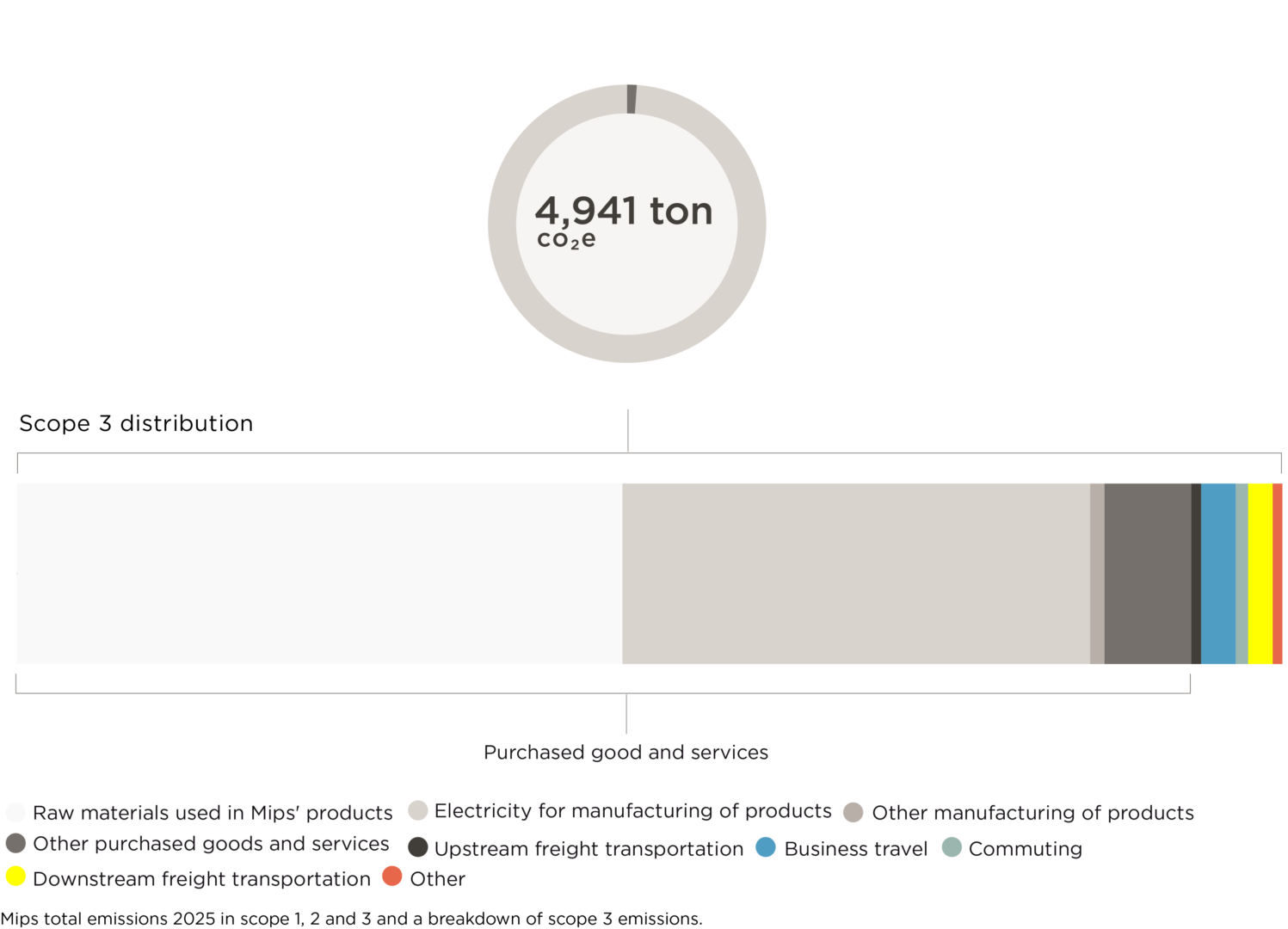
Mips actively collaborates with its partners in the value chain to jointly achieve continuous improvements in the areas of resource use and circular economy. Together with its suppliers, Mips is working to increase the proportion of recycled materials and reduce waste. Mips long-term target in this area is to achieve 90 percent recycled material in sold products by 2030. In 2025 Mips reached 34 percent recycled material.
Part of Mips´vision is to use Mips´technology so that helmets in all categories protect users better than current test standards promote.
Mips is a pioneer in this important field, so it is vital that the company can attract and retain employees with the right skills and passion to always make safer and better products. Even though Mips is the world leader in its field, Mips´people are modest and curious, with a desire to learn more. Mips´employees constantly challenges themselves and the company encouranges all employees to bring the best of themselves to work every day.
Mips does not conduct any of its own production and instead uses external suppliers for product manufacturing. Mips has committed to adhere to the UN Global Compact and its ten principles on human rights, labor, the environment and anti-corruption. These ten principles are incorporated in Mips´Code of Conduct for Suppliers. To ensure that Mips´suppliers adhere to Mips´Code of Conduct, Mips audits manufacturing suppliers at least every other year. How well each supplier meets the requirements within these areas is summarized in an audit score. Based on this, an average score is calculated for all manufactuting suppliers. The maximum score is 100, and the average score in 2025 was 94.
Sustainable societal development is extremely important for us, we believe that our technology and products lead to a more sustainable society since they are designed to improve helmet protection for both recreational and professional use. Improved helmet protection leads to increased safety and security while reducing risk for both short-term and long-term sick leave, as well as permanent injury.
Mips´business activities are characterized by responsibility and a long-term perspective. Stakeholders must be able to trust that Mips fulfills its promises throughout the entire business process. This is how Mips builds trust with customers, employees, suppliers, and other important partners. Mips´risk analysis forms the basis of the priorities and key areas the company has focused on to ensure business is conducted responsibly.